Stop Debating Models. Start Building Scaffolding.
- Ted Lango
- Jan 29
- 2 min read

The Future of Work Isn't About Which AI. It's About How You Use It.
The future of work isn't coming. It's here. And while everyone debates which model is best—Claude Opus 4.5, ChatGPT 5, Gemini, Grok—they're missing the point entirely.
The model isn't the answer. The scaffolding is.
The Wrong Conversation
Every week brings another benchmark. Another model comparison. Another "this one is 3% better at coding" or "that one finally beats humans at reasoning."
Employers ask: Which AI should we buy?
Employees ask: Which AI will take my job?
Both questions assume the model is the product. It's not.
The model is the engine. What matters is the vehicle you build around it—and whether you know how to drive.
The Real Shift
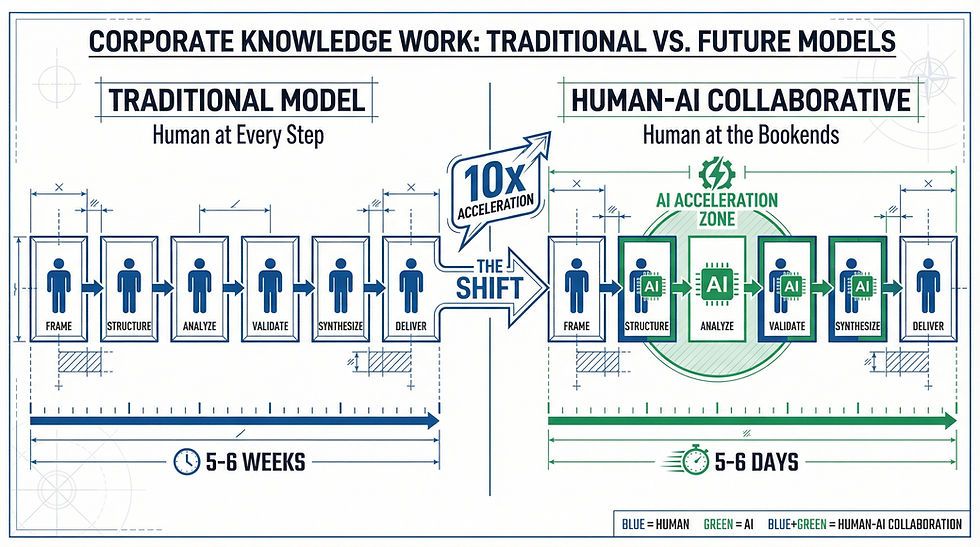
Traditional vs. Human-AI Collaborative Knowledge Work
Here's what's actually changing:
Before: Humans at every step. Analysis takes weeks. Bottlenecks everywhere.
After: Humans at the bookends. AI accelerates the middle. Same work in days.
The shift isn't about replacing humans. It's about repositioning human value to where it matters most:
· Defining the problem (no AI can tell you what should be measured)
· Validating causal claims (someone has to own the consequences)
· Delivering to stakeholders (trust is relational)
Everything in between? That's the acceleration zone.
The Scaffolding Beneath
What separates organizations that thrive from those that flounder isn't their choice of model. It's their understanding of three things:
1. When to use deterministic code
Some things shouldn't be probabilistic. Data validation. Audit trails. Confidence tracking. Build these in code, not prompts.
2. When to use probabilistic LLMs
Pattern recognition. First drafts. Hypothesis generation. Synthesis across sources. Let the model do what models do well.
3. Where humans must remain
Problem framing. Causal judgment. Stakeholder relationships. Accountability. These aren't limitations—they're the point.
The magic isn't in any single component. It's in the handoffs between them.
What This Means
For employers: Stop asking "which AI" and start asking "what workflow." The competitive advantage isn't the model—it's the scaffolding that lets your people work with it effectively. Invest in the infrastructure, not just the subscription.
For employees: Your value is shifting, not disappearing. The analysts who thrive won't be the ones who can run the most regressions. They'll be the ones who can frame the right questions, validate causal claims, and translate findings into action. Learn to work at the bookends.
For everyone: The organizations that win will be those that redesign workflows for human-AI collaboration—not those that try to do everything with humans, nor those that try to remove humans entirely.
The Bottom Line
The model wars are a distraction.
The real question isn't which AI. It's how you scaffold human judgment around probabilistic intelligence to create something neither could achieve alone.
The shift is underway. The scaffolding is the strategy.
The handoff is the design.


